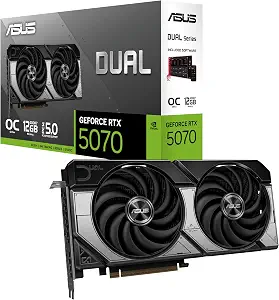
ASUS Dual GeForce RTX 5070 12 GB GDDR7 OC Edition Buying Guide — Black Friday Deals 2026
When you shop for an ASUS RTX 5070, which details should decide whether this particular card belongs on your shortlist? Start with the essentials you can verify: its memory specification, named graphics technologies, clock detail and display outputs. Then consider the fan description and the kinds of use it explicitly addresses. During Black Friday, the event label alone does not tell you whether a listing is for the exact model you want. Treat the feature list and the listing identity as separate checkpoints, and make the offer comparison only after both are clear.
The ASUS Dual GeForce RTX 5070 12 GB GDDR7 OC Edition brings together 12 GB GDDR7 memory, NVIDIA Blackwell architecture, DLSS 4 and an OC Mode clock speed of up to 2572MHz. Those are concrete details to compare against your own priorities, not a promise about results for a particular game or workload. Its HDMI 2.1b and DisplayPort 2.1b outputs also give you specific connection names to check against the displays you intend to use.
This card is a reasonable shortlist candidate if those named features align with what you want to consider, and if the fan details matter to your day-to-day use. For Black Friday, identify the full ASUS Dual variant in the listing before evaluating its offer. Avoid treating a broad RTX 5070 label as confirmation that the page describes this exact OC Edition.
Put the memory figure beside your actual workload
The listed memory is 12 GB GDDR7. Use that as a defined specification when comparing the ASUS RTX 5070 with your intended tasks; the figure alone does not establish how a particular game or application will behave. If memory is high on your shortlist, make sure you are comparing the same capacity and memory type rather than relying on a product-family name or a Black Friday headline.
It can help to write down what you want the card to do, then keep the listed specification beside that plan. This avoids asking the memory detail to answer questions it cannot settle on its own. If another priority matters more to you, such as the display connections or the named architecture features, weigh those separately. Black Friday is a useful time to compare listings, but a deal label should not replace a careful read of the specifications.
Consider the named graphics technologies on their own terms
The card is powered by NVIDIA Blackwell architecture and DLSS 4. Those names may be relevant if you are specifically looking for them, but the supplied details do not quantify the experience in any game or describe results for a particular setup. Keep the distinction clear: these are features to include in your comparison, not a guarantee that every title or task will benefit in the same way.
Before Black Friday, decide whether these technologies are part of your must-have list or simply useful extras. Then check that the listing for the ASUS Dual variant actually names the features you care about. This staged approach keeps the shortlist focused: establish what matters first, consider the additional technologies next, and only then compare the exact offer. It also makes it easier to avoid choosing by a broad marketing phrase without checking the card-specific details.
Keep the OC Mode clock in its stated setting
The published clock detail is up to 2572MHz in OC Mode. Keep both parts of that wording together: it is an up-to figure, and it is associated with OC Mode. That makes it a precise point of reference for your comparison without turning it into a claim about clock behavior in every situation or a prediction of performance.
If clock information is important to your shortlist, compare this specification with the corresponding details on other listings and note the mode attached to each figure. During Black Friday, avoid letting a large-looking number make the decision by itself. Confirm that you are comparing the same kind of specification and the exact variant, then balance it against features you may use more directly, such as memory, outputs or the stated fan design.
Map the output names to your display plans
The listed outputs are HDMI 2.1b and DisplayPort 2.1b. Before buying, write down which connection names your intended display setup calls for and compare that list with the card’s stated outputs. This is a straightforward fit check; it does not require assuming anything about the displays or setup beyond what you already know.
Keep this check in the practical-fit stage of your Black Friday shortlist. A listing may emphasize architecture or clock details, but those do not answer which output names are provided. Verify the exact ASUS Dual listing and read the output specification there before weighing the offer. If these are the connection names you need to evaluate, they provide a clear comparison point; if your plans call for other details, seek those details rather than inferring them.
Read the fan features with their qualifications intact
ASUS describes an axial fan design with a smaller fan socket that facilitates longer blades, plus a barrier ring that increases downward air pressure. The description gives you design details to consider, but it does not specify temperatures, noise levels or results in a particular case. Use it as an explanation of the stated fan design, not as a substitute for information that is not provided.
The product also specifies 0dB technology, which allows you to enjoy light games in relative silence. Keep that qualification intact: the stated use is light games, and the wording is relative silence, not a promise of silence in every situation. For Black Friday, decide whether that particular use case is meaningful to you, then verify that the offer names this card and its fan features. If cooling behavior is a deciding factor, do not assume a specific outcome from the design description alone.
Make the Black Friday offer check model-specific
Before comparing offers, confirm that the product page identifies the ASUS Dual GeForce RTX 5070 12 GB GDDR7 OC Edition, rather than relying only on a general RTX 5070 label. Check the variant name and the details that matter to your decision, including memory, OC Mode clock and outputs. If a page’s information is unclear, do not fill in the gaps by assumption.
Next, compare the complete offer shown for that exact listing with any other listing you are considering. No price or discount is established here, so judge what is actually presented to you rather than expecting a particular Black Friday promotion. Recheck the variant before checkout, since a comparison is useful only when the products being compared are the ones you intend to choose. This final verification keeps the decision grounded in the listed card and the offer in front of you.
Key specs
| Memory | 12 GB GDDR7 |
| Architecture and upscaling | Powered by NVIDIA Blackwell architecture and DLSS 4 |
| OC clock | clock speeds up to 2572MHz in OC Mode |
| Display outputs | HDMI 2.1b, DisplayPort 2.1b |
| Fan design | Axial fan design features a smaller fan socket that facilitates longer blades, and a barrier ring that increases downward air pressure |
| Fan technology | The 0dB technology allows you to enjoy light games in relative silence |
Make your Black Friday choice
A focused decision comes down to fit first, useful extras next, and listing verification last. Decide whether 12 GB GDDR7 and the named outputs suit your plans; then weigh Blackwell architecture, DLSS 4, the OC Mode clock and the qualified fan details according to your priorities. For Black Friday, finish by checking that the page names this exact ASUS Dual OC Edition and comparing the complete offer as presented. That checklist is more dependable than deciding from the event label alone.