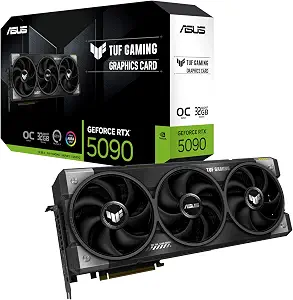
 Check Price on Amazon
ASUS TUF Gaming GeForce RTX 5090 32GB GDDR7 OC Edition Gaming Graphics Card Buying Guide — Black Friday Deals 2026
An RTX 5090 purchase calls for more than a glance at the graphics-card name: the useful shortlist starts with physical fit, then moves to the connections and specifications that matter for your setup, and ends with a careful check of the exact listing. This ASUS TUF Gaming GeForce RTX 5090 32GB GDDR7 OC Edition pairs 32 GB of GDDR7 memory with a stated set of native video outputs and two listed clock modes. Those details help frame questions about planned workloads and displays, but they do not settle whether the card is the right choice for every system. During Black Friday, treat the event as a reason to compare the precise model and offer—not as proof of a discount or a reason to skip the fit check.
This is a compelling shortlist candidate for shoppers whose priorities include the listed 32 GB of GDDR7 memory and a broad set of native display connections. Its five stated outputs comprise Native DisplayPort 2.1a x3 and Native HDMI 2.1b x2. That makes it worth mapping against the displays you plan to connect, rather than assuming the output mix suits every arrangement. The product is also identified as an OC Edition, with a default mode boost clock of 2550 MHz and an OC mode clock of 2580 MHz. These are configuration details to consider, not a promise of a particular result in a game or application.
The card measures 13.7"L x 5.7"W, so make its stated dimensions part of your early fit decision. Axial-tech fans are the listed cooling feature; weigh that detail alongside the rest of the specifications rather than treating it as a guarantee of noise or temperature. I would label it Best for native display planning because the provided output list gives shoppers specific connection types to compare with their intended setup. That label reflects a useful decision point, not a claim that it is superior in measured performance. Around Black Friday, verify that the listing you are considering is this exact model and variant before weighing the offer.
Put physical fit at the start of your Black Friday shortlist
Begin with the card’s stated dimensions: 13.7"L x 5.7"W. Compare those measurements with the space available in your planned build, and check any relevant clearance information for that specific setup before deciding. The provided dimensions are useful for screening, but they do not establish compatibility with a particular case or system. If you cannot confirm the available space, pause the purchase rather than treating the RTX 5090 name as enough to answer the fit question.
This order matters during Black Friday, when an attractive-looking listing can make it tempting to focus on the offer first. Keep the steps separate: establish whether the listed footprint can work for your intended build, then move on to features and listing details. If the card’s dimensions do not fit your plans, its memory, outputs, and clock entries will not resolve that practical obstacle. If fit remains uncertain, use the exact product information and your system’s own measurements to clarify it before buying.
Decide what 32 GB of GDDR7 means for your plans
The stated memory specification is 32 GB of GDDR7. Treat it as a point for matching the card to the work you expect to do, not as a blanket promise that every workload will benefit in the same way. Ask what applications or games matter to you, what requirements you rely on, and whether you have a specific reason to prioritize the listed capacity. Those questions make the number relevant to your decision without assuming performance outcomes that are not established by the specification.
For Black Friday comparisons, look beyond a broad RTX 5090 label and confirm that the exact ASUS TUF Gaming model and 32 GB GDDR7 specification appear on the offer you are evaluating. A listing with a similar family name is not a substitute for confirming the actual variant. If memory capacity is central to your shortlist, keep that requirement visible while you compare; if it is not central, give physical fit and planned connections their proper place instead. The specification is a useful filter, not a complete buying decision.
Match the native outputs to the displays you intend to use
The published output list is Native DisplayPort 2.1a x3 and Native HDMI 2.1b x2. Make a simple connection plan from the displays you intend to use, noting which of those native connection types each one calls for. This turns the output list into a practical check instead of a feature that merely sounds useful. The listed ports can inform your planning, but they do not establish details about a particular display or the rest of your system.
This is also a useful differentiator when reviewing Black Friday listings. Confirm the output specification for the exact model rather than assuming every card carrying an RTX 5090 name has the same listed configuration. If your planned displays do not match the connections shown here, resolve that question before purchase. If they do, the native outputs may be a meaningful reason to keep this card on your shortlist. Either way, let your actual display plan—not the size of the output list alone—drive the decision.
Read the clock modes as listed configurations
The product details give a default mode boost clock of 2550 MHz and an OC mode clock of 2580 MHz. Keep those entries in their stated context: they identify two listed configurations for this card. The figures do not, by themselves, establish what you will experience in a particular game, application, or system. If clock mode matters to your decision, note which mode you are comparing and avoid turning the difference between the entries into a broader performance conclusion.
During Black Friday, use the clock information to confirm you are looking at the OC Edition described here, not to infer that a deal delivers a particular result. Compare like with like: exact model, stated mode information, and the rest of the specifications you care about. If the clock entries are less important to your intended use than dimensions or display connections, prioritize those practical checks instead. A clear buying order helps keep one prominent specification from overshadowing the questions that actually determine whether the card fits your plans.
Give the fan detail useful, limited weight
Axial-tech fans are the cooling feature stated for this card. That information is worth noting if cooling design is part of your shortlist, but the fact alone does not establish noise levels, temperatures, or behavior in your particular setup. Consider it alongside the card’s dimensions and the other specifications you can verify. Avoid treating the fan description as a substitute for checking your own needs or as evidence of a result that is not provided.
As Black Friday approaches, keep your comparison grounded in facts that are actually listed. If two offers appear similar, confirm the exact model and compare their stated details rather than assuming a fan label settles which is preferable. You can give the axial-tech fan feature more or less weight depending on what matters in your build, while keeping the conclusion appropriately narrow. The goal is not to turn every specification into a promise; it is to use each one as a useful question in a deliberate shortlist.
Key specs
| Graphics memory | 32 GB |
| Memory type | GDDR7 |
| Video outputs | Native DisplayPort 2.1a x3, Native HDMI 2.1b x2 |
| Default boost clock | Default mode: 2550 MHz(Boost clock) |
| OC mode clock | OC mode: 2580 MHz |
| Card dimensions | 13.7"L x 5.7"W |
| Cooling features | Axial-tech fans |
Make your Black Friday choice
A sensible decision sequence is straightforward: check whether the stated 13.7"L x 5.7"W dimensions work for your planned space, map the native outputs to your displays, and then weigh the 32 GB of GDDR7, clock entries, and Axial-tech fans against your priorities. For Black Friday, finish by verifying the exact model and variant on the listing and comparing the specific offer without assuming a promotion or savings. If those checks align with your needs, this card has a clear case for consideration; if a key detail remains uncertain, resolve it before committing.