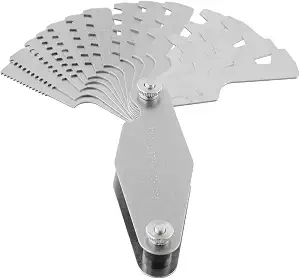
for acme Thread Pitch Gauge
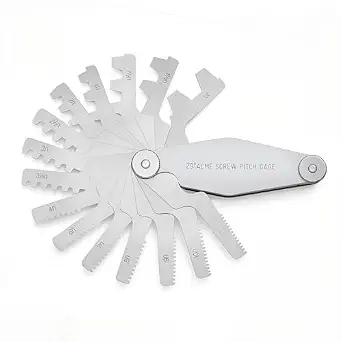
29 Degree Acme Screw Pitch Gauge Stainless T-Thread Cutting Tool Set 16pcs
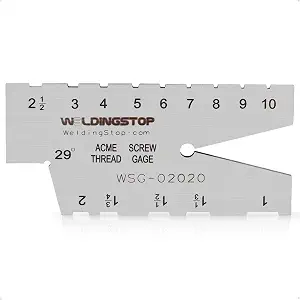
ACME SCREW THREAD GAUGE 29 DEGREE GRINDING GAGE TOOL
Best Acme Tool Buying Guide — Black Friday Deals 2026
Acme-thread work calls for more than a quick glance at a product name: the stated angle, the pitch or size coverage, and the gauge’s format all matter. This guide compares three listed options with different kinds of coverage, from a fourteen-blade gauge with a stated 2P to 20P range to a single-piece tool and a 16-piece set with listed thread sizes. Use your work requirement as the first filter, then decide which format provides the information you need. During Black Friday, compare the exact item and its stated specifications rather than assuming a promotion makes unlike gauges interchangeable. No offer is assumed here; the right choice depends on a match to your measurement task.
for acme Thread Pitch Gauge
Best Overall is the editorial choice for shoppers whose first priority is a clearly stated pitch range in a compact list of specifications. This gauge lists a 30° thread angle, a 2P to 20P pitch range, and fourteen for blades. Those details give you concrete points to compare with the thread and tool requirements in front of you. The angle is especially important to check rather than gloss over: the other featured gauges state 29°, so do not treat the listed angles as the same. The Best Overall label is a guide to how this set of supplied details may suit a broad initial shortlist, not a claim of measured superiority.
For an everyday inspection, first identify the pitch information you need and check whether it falls within the listed range. Then consider whether the stated angle corresponds to the work requirement. The listing identifies the material as quenched stainless iron and gives dimensions of 5.91 x 1.97 x 0.79 inches. These are useful identification details when comparing listings or planning how a gauge fits into your work area, but they do not establish unlisted qualities such as precision, resistance to wear, or suitability for a particular machine. Its fourteen for blades are another stated point to review; the provided information does not enumerate individual blade pitches.
On Black Friday, this is a sensible candidate when the stated range and angle align with the job you actually need to check. Verify that the exact listing still names the same 30° angle, 2P to 20P range, blade count, material, and dimensions before comparing its offer with another product. If your work instruction calls for a different angle, a pitch entry not established by the stated range, or a specific blade configuration, pause and confirm the details rather than inferring them from the product name. This gauge earns its Best Overall place here because its supplied specifications make a practical starting point for a range-based comparison, while leaving task-specific fit to your own requirements.
Key specs
| Thread angle | 30° |
| Pitch range | 2P to 20P |
| Blade count | Fourteen for blades |
| Material | quenched stainless iron |
| Dimensions | 5.91 x 1.97 x 0.79 inches |
29 Degree Acme Screw Pitch Gauge Stainless T-Thread Cutting Tool Set 16pcs
Check Price on Amazon
Best for Broad Listed Size Coverage is the editorial label for this 16-piece 29 Degrees ACME Screw Pitch Gauge set. Its provided size list runs from 1 in through 12 in, with entries including 1-1/3, 1-1/2, 1-3/4, 2-1/2, and 3-1/2 in. That makes the list itself the key reason to consider this option: compare each size you need against the stated entries, rather than relying on the broad-sounding set name. The label describes a useful characteristic of the listed coverage; it does not establish that this is more capable or suitable than another gauge for every task.
The product information says the set measures internal and external screw threads with thread blades of varied size. That stated purpose can help shoppers decide whether its described measurement approach is relevant to their work. It is made of stainless steel, and the scale is described as laser engraved; the listing also calls it durable and not easy to wear. Treat those as the stated construction and marking details, not as a guarantee of service life. Most importantly, its listed angle is 29°. Check that angle separately from the size entries, since matching a size alone does not establish that the tool is right for a particular thread.
For Black Friday, use the full size list as a verification checklist before weighing the exact offer. Confirm that the listing identifies the 16-piece set and the size entries you need, and check the stated angle and internal-and-external measurement purpose as well. Do not assume that a deal on a similarly named item covers this same set or its listed contents. If your task calls for a size that is not explicitly listed, seek confirmation instead of treating the ends of the list as proof of additional coverage. This set is most compelling for a shopper whose required sizes appear in its stated lineup and who wants the described multi-piece format.
Key specs
| Set contents | 29 Degrees ACME Screw Pitch Gauge 16 pcs set |
| Thread sizes | 1, 1-1/3, 1-1/2, 1-3/4, 2, 2-1/2, 3, 3-1/2, 4, 5, 6, 7, 8, 9, 10, 12 in |
| Material | The Screw Thread Pitch gage is made of stainless steel |
| Measurement | Measures internal and external screw threads with thread blades of varied size |
| Scale | Laser engraved scale is not easy to wearand durable |
ACME SCREW THREAD GAUGE 29 DEGREE GRINDING GAGE TOOL
Check Price on Amazon
Best Budget is the editorial choice for shoppers who want to consider a single-piece gauge and have a stated range to compare against their work. The listing describes a 29 degree stainless steel acme thread gauge as a single piece type and gives its range as 1-10TPI. It also lists pitches as 1, 1-1/3, 1-1/2, 1-3/4, 2, 2-1/2, 3, 4, 5, 6, 7, 8, 9, and 10. The Best Budget label is an editorial distinction among these products, not a statement about current pricing or proof that it costs less.
The described use is measuring thread and external thread tooth pitch, and the listing also calls it a standard gauge for checking the angle of screw cutting tools. Its scales are laser engraved. Those details may make it worth considering when the task involves the checks named in the listing and the stated pitch entries fit your requirements. The single-piece format is a useful distinction to weigh against the 16-piece set, but the supplied facts do not establish a storage arrangement, adjustment method, or any other construction detail. Likewise, stainless steel and engraved scales are facts to compare, not evidence for unlisted performance claims.
During Black Friday, treat the budget label as a prompt to compare the exact offer, not a reason to assume a discount or a particular price. Check that the listing still describes the single-piece 29 degree gauge and the 1-10TPI range, then compare its pitch entries with the specific work requirement. If you need internal-thread measurement, note that this product’s supplied use description mentions thread and external thread tooth pitch; do not extend that wording to claims not provided. This option earns its label because its stated format and pitch information may suit a focused shortlist, provided the angle and listed checks correspond to your task.
Key specs
| Type | The 29 degree stainless steel acme thread gauge is a single piece type |
| Use | it is applied to measure thread and external thread tooth pitch. |
| Range | The acme thread gauge range:1-10TPI |
| Pitch | the pitch:1,1-1/3,1-1/2,1-3/4,2,2-1/2,3,4,5,6,7,8,9,10. |
| Tool check | Standard gauge for check the angle of screw cutting tools |
| Scale marking | All the scales on the acme screw gauge are laser engraving |
Turn a work requirement into a first-pass filter
Before browsing, write down what the job actually calls for: the thread angle, the pitch or size notation, and whether the task is to inspect a thread or check a cutting tool. These are separate questions. A product name that includes ACME does not by itself establish that every listed gauge is right for every ACME-related task. In this group, two products state 29° or 29 degree, while the for acme gauge states 30°. Compare that wording against the requirement you have, and do not round or treat the values as equivalent.
Next, compare the requested pitch or size with the coverage the listing actually gives. The for acme gauge states 2P to 20P; the single-piece gauge gives a 1-10TPI range and enumerates pitches; the 16-piece set provides a list of thread sizes in inches. Those descriptions use different forms of coverage, so a broad-looking range should not be translated into entries the listing does not name. During Black Friday, this first-pass filter helps keep an attractive-looking offer from distracting you from basic fit. If a necessary detail is not established, leave the candidate unresolved until you can verify it.
Choose the coverage format that answers your question
The three formats present information differently, and that difference can guide a shortlist. One gauge gives a pitch range and a blade count; another identifies a single-piece type and enumerates pitch entries; the third is described as a 16-piece set with thread sizes listed. Consider which description maps most directly to the notation on your work order. If you routinely begin with a specified pitch, an explicitly listed pitch entry may be easier to compare than a size list expressed in inches. If your task is defined by a stated range, use that range literally and confirm the unit or notation your work requires.
Do not assume that more pieces automatically mean a better match, or that a single-piece type is automatically simpler for your particular routine. The supplied facts establish formats and coverage details, not the time each takes to use or how conveniently it can be stored. For Black Friday, compare the exact set contents or stated range attached to the offer you are considering. A similar product title may not answer whether the piece count, size list, or pitch details match the item you meant to shortlist. Focus on the listed information that resolves your task, then treat any unconfirmed convenience as an open question.
Keep angle, measurement purpose, and pitch distinct
Angle should be an early checkpoint, but it is not the only one. The two gauges that state 29 degrees also describe different formats and coverage: one is a single-piece gauge with listed pitches and a tool-angle checking purpose, while the other is a 16-piece set described for measuring internal and external screw threads. The for acme gauge states 30° and gives a pitch range. Those distinctions show why matching the angle alone is not enough to settle a purchase. First confirm the angle required for the task; then check that the product’s stated measurement purpose and coverage also make sense.
Keep the original labels in view when comparing specifications. The single-piece listing uses 1-10TPI for its range and separately lists pitches; the 16-piece set lists sizes in inches; the for acme gauge states 2P to 20P. The information provided does not explain how to convert between these notations, so do not perform an assumed conversion to make a product appear to fit. If your notes use a different notation, verify the match before buying. A careful Black Friday shortlist is built from confirmed requirements, not from a guess that two ways of describing coverage mean the same thing.
What the listed materials and markings can tell you
Material and scale details can help distinguish entries, provided they are read narrowly. The for acme gauge is described as quenched stainless iron. The other two listings say stainless steel. One describes its scale as laser engraved and calls it durable and not easy to wear; the single-piece gauge says its scales are laser engraving. These are useful statements to check against the exact product listing, but they do not establish unprovided information such as accuracy, expected lifespan, corrosion behavior, or suitability for a particular environment.
Likewise, dimensions are available for the for acme gauge as 5.91 x 1.97 x 0.79 inches, but the supplied facts do not give dimensions for the other two. Use the available measurement only if those exact dimensions matter to your work area or comparison; do not infer how the other products would fit. During Black Friday, a listing may emphasize one material or marking claim more prominently than the coverage details. Keep the essentials in front of you: angle, stated measurement purpose, and the exact range or entries needed. Construction details can refine a choice once those core requirements are satisfied.
A Black Friday checklist for the exact listing
Black Friday shopping is most useful when you compare the same kind of item rather than only comparing promotional language. Open the exact listing and check its full product identity, stated angle, format, and coverage. For the set, verify that it is the 16-piece version and review the listed thread sizes. For the single-piece gauge, confirm the range and the pitches you need. For the for acme gauge, check the stated 30° angle, 2P to 20P range, and fourteen for blades. These checks reduce the chance of judging an offer by a title that leaves a key distinction unclear.
Then assess the offer as presented without assuming a particular discount, stock status, or promotion. Compare only details the listing actually provides, and verify that the selected item or variant corresponds to the specifications you used to make your decision. If the offer does not make a necessary fact clear, treat that as a reason to pause and seek confirmation rather than filling the gap with an assumption. A fair comparison also means weighing unlike formats on their own terms: a size list, a pitch range, and a single-piece description answer different questions. The best Black Friday decision is the one that preserves the task match after the promotional framing is set aside.
Make your Black Friday choice
A useful shortlist begins with the requirement, not the promotion: confirm angle, identify the pitch or size notation, and decide which stated measurement purpose matters. Then compare the exact coverage and format each gauge provides. The 30° range-based gauge, the 29 degree single-piece tool, and the 29 Degrees 16-piece set each present different facts for that decision. For Black Friday, verify the precise listing and offer without assuming that a deal changes what the tool can check. When a needed specification is unclear, pause for confirmation. That simple final step keeps the choice grounded in the work you need to do.